
As science advances and access widens, HBOT is entering the mainstream. The only question now is who leads the way?
For most of its modern history, Hyperbaric Oxygen Therapy has lived a double life. Inside hospitals, it has been a dependable, quietly effective clinical tool , treating decompression sickness, carbon monoxide poisoning, diabetic ulcers and radiation injury. Outside those environments, it has often been under-appreciated or unevenly understood, despite a long-established scientific foundation.
That landscape is shifting. Across healthcare, human performance and the fast-developing wellbeing economy, HBOT is entering a new phase of attention and investment. Crucially, this resurgence is not driven by fad or fashion but by the convergence of physics, physiology and unmet human need.
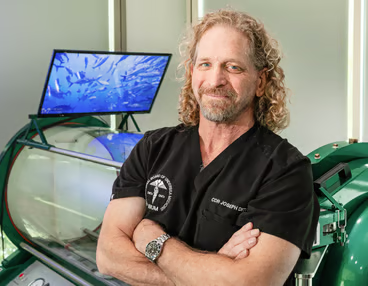
Few figures illustrate this shift more clearly than Dr Joe Dituri aka Dr Deep; Doctor, scientist, former US Navy saturation diver and hyperbaric researcher at the University of South Florida. His forthcoming clinical trial, officially registered as NCT06581003 on ClinicalTrials.gov, will evaluate whether 40 sessions of 2.0 ATA oxygen can reduce neurobehavioral symptoms and improve functional outcomes in U.S. veterans with mild to moderate traumatic brain injury. The study, scheduled to begin in early 2026, uses a randomised, blinded, adaptive, placebo-controlled design an approach that reflects the growing emphasis on structured investigation within the ‘mild’ HBOT space.”
Physics, Not Philosophy
What makes HBOT distinctive, and persistently misunderstood, is that it does not rely on belief, branding or interpretation. It rests on physics. Henry’s Law, Boyle’s Law, Dalton’s Law and Fick’s Law define how oxygen dissolves, diffuses and behaves under pressure. These laws do not soften in a spa, intensify in a clinic, or adjust themselves to marketing language. Understanding this point is essential, because it leads naturally to the reframing that may now be key to reshaping the entire field.
HBOT Is A Dosed Intervention. Not An Experience
One of the most overlooked truths about HBOT is that it behaves far more like a medication than a relaxation modality.
"Just as a medication only works when taken at the correct dose, interval and duration, HBOT only works as intended when pressure, oxygen concentration, session length and frequency are structured with the same discipline. The chamber provides the environment, but the protocol delivers the therapy.”
Once HBOT is understood in these terms, the true leverage point becomes clear. The “prescribed dose” is shaped by four variables:
- Pressure :the delivery mechanism
- Duration : the exposure window
- Oxygen concentration : the active ingredient
- Frequency : the cumulative therapeutic effect
“These laws don’t bend. They don’t care what you believe. They simply govern the dose.” Dr Joe Dituri
Why the OTC Analogy Matters
Even over-the-counter drugs require correct dosing to remain safe and effective. HBOT is no different. The chamber creates the environment; the protocol and the oxygen dosage is the therapy. When HBOT is delivered without structure, it becomes unpredictable. When delivered well, no different to prescribing a drug, it becomes a consistently effective, physiologically grounded intervention. Seen through this lens, Oxygen is a drug and prescribing a dose is a matter of clinical qualification, or the right approved formulation for “consumer” OTC use. This insight is driving the shift from “sell the chamber” to “deliver the therapy”, and it’s why capability will define the next-generation HBOT landscape.
The 2.0 ATA Inflection Point
Across studies on neurological injury, inflammation, metabolic dysfunction, cellular repair and mitochondrial dynamics, 2.0 ATA consistently emerges as the practical, scalable point where physiology begins to shift in meaningful ways.
At this pressure, roughly twice the atmospheric pressure we live under at sea level, the amount of oxygen dissolved in blood plasma increases dramatically, increasing oxygen availability in tissues where supply has been reduced.This enhanced oxygen presence has been shown to:
- increase tissue oxygen tension significantly
- support cellular metabolism under stress
- modulate inflammatory signalling in certain conditions
- enhance tissue-repair physiology in wound-healing contexts
“Most of the meaningful physiology sits around 2 ATA. Above that, the risk curve rises faster than the benefit curve.”
Above 2 ATA, the risk–complexity curve steepens rapidly: oxygen-toxicity management, required air breaks, clinical monitoring and insurer requirements escalate. At 2.0 ATA, however, there is a clear operational equilibrium.
Why 2.0 ATA Is the Sweet Spot
- Powerful enough to matter
- Controlled enough to deliver safely outside a hospital
- Simple enough to avoid clinical complexity
- Predictable enough for insurers
- Accessible enough to scale
This pressure range is not a branding choice. It is a practical, physiological, insurable, evidence-aligned intersection. It is the HBOT tipping point.
Not Everything That Inflates Is HBOT
1.5 ATA Soft-shell chambers have a role in the oxygen ecosystem. They offer a low-pressure environment suitable for light wellness support. But they are not equivalent to hard-shell, 2.0 ATA HBOT. As HBOT enters the mainstream, this distinction will matter, not because of competition, but because the difference between “oxygen exposure” and “oxygen therapy” is dose, not aesthetics. And dose is what determines outcomes. Which is why dose, and the competence to deliver it, will define the next wave of leadership.
Training, Governance and the Insurer Lens
Regulators will eventually catch up. But insurers rather than regulators may become the immediate gatekeepers shaping the practical future of HBOT. As HBOT is rapidly spreading into gyms, hybrid recovery spaces, performance studios and wellbeing centres, insurers are likely to start asking the questions that matter:
- What protocols exist?
- Are operators trained?
- How are clients screened?
- What emergency procedures are in place?
- Are claims defensible and evidence-aligned?
Insurers respond to risk, not industry hype. They define standards by what they agree to underwrite. And in HBOT, underwriting will rapidly become one of the regulators of best practice. .
This shift toward competence is already redefining expectations. The International Board of Undersea Medicine (IBUM), led in part by pioneers like Dituri, is emerging as the benchmark for how clinicians and operators are trained. BTN is committed to amplifying this movement: elevating awareness of IBUM’s standards and embedding IBUM-aligned training into our own ecosystem to help raise the baseline of capability across the sector.
Beyond The Norm's Place In the Resurgence
Beyond The Norm was founded to be positioned precisely where the field is now heading.
- 2.0 ATA engineering built for real-world use
- Governance and standards aligned with insurer expectations
- Evidence-led operator training that reflects the physics, not the marketing
- Clinical insight and research from pioneers like Dr Dituri
“Capability will determine who participates in the next wave of HBOT growth.”
Our role is to:
- provide HBOT environments engineered around safe, predictable 2.0 ATA delivery
- align operational practice with insurer, clinical and scientific expectations
- integrate evidence-led clinician and operator training
- operate with the discipline that physics demands and insurers increasingly require
HBOT is not fringe. It is not a fad. It is a tool with profound potential.
The resurgence has begun. The opportunity ahead is extraordinary.
Leadership, not hardware, will define the future.